Leopard Seamless Patterns: Practical Design Assets for Creative Professionals and Everyday Projects
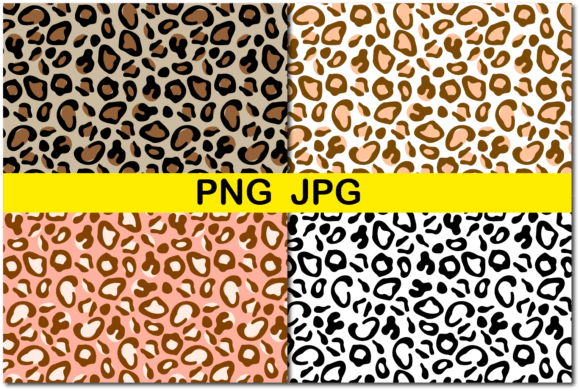
Leopard seamless patterns occupy a distinctive space in the world of digital design assets—not as fleeting trends, but as enduring, versatile tools grounded in visual rhythm, natural texture, and cross-disciplinary utility. Unlike static graphics or one-off illustrations, seamless patterns repeat infinitely without visible seams, enabling scalable application across surfaces, layouts, and media. The Leopard Seamless Patterns collection—comprising four distinct, high-fidelity designs—offers precisely this functionality with technical precision and aesthetic cohesion.
What Makes These Patterns “Seamless”—and Why It Matters
A seamless pattern is engineered so that its edges align perfectly when tiled horizontally and vertically. This isn’t merely about visual continuity; it’s about functional adaptability. When a background repeats without interruption, designers avoid awkward cuts, mismatched edges, or manual cloning—saving time and preserving fidelity across formats. In practice, this means a single 12 x 12 inch tile can fill a business card or a billboard-sized banner without distortion or repetition artifacts.
The Leopard Seamless Patterns collection delivers this reliability at 300 dpi resolution—the industry standard for print-ready output. At this density, each pixel retains clarity even when enlarged for signage, fabric printing, or large-format wall graphics. Because the patterns are built on a square canvas (12 inches by 12 inches), they integrate predictably into common design workflows: Adobe Photoshop layers, Illustrator swatches, Figma auto-layouts, Canva templates, and even CSS background-repeat declarations.
Four Designs, One Unified Purpose
Though unified by theme and technical specs, the four included patterns offer deliberate variation in tone, scale, and contrast:
- Subtle Roar—A low-contrast interpretation with soft-edged spots and muted warm undertones, ideal for professional presentations, educational handouts, or minimalist packaging.
- Wild Contrast—High-definition black-and-gold spotting with sharp definition, suited to editorial layouts, fashion mood boards, or luxury branding elements.
- Textured Ground—Incorporates faint grain and subtle tonal layering beneath the leopard motif, lending depth for tactile applications like stationery, textile mockups, or UI backgrounds where dimensionality enhances usability.
- Minimal Outline—A stylized, line-art version of the leopard spot, stripped of shading and color fill—perfect for vector-based customization, embroidery digitizing, or monochrome laser engraving previews.
This curated variety reflects an understanding that “leopard” isn’t a monolithic aesthetic—it’s a flexible visual language. A biology educator might use Subtle Roar to soften scientific diagrams; a boutique owner could apply Wild Contrast to gift wrap or hang tags; a web developer may embed Minimal Outline as a lightweight SVG-compatible fallback via PNG transparency.
Two Formats, One Workflow Advantage
Each of the four patterns is delivered in both JPG and PNG formats—eight files total, organized intuitively. This dual-format approach addresses real-world constraints:
- JPG files provide universally compatible, compressed raster data—ideal for email attachments, CMS uploads, PowerPoint slide backgrounds, or quick client previews where file size matters more than transparency.
- PNG files retain full alpha channels, meaning transparent backgrounds. This enables non-destructive layering over photos, gradients, or complex compositions—essential for product mockups, social media banners with overlaid text, or layered print collages.
Unlike generative AI outputs or free web downloads, these files were manually refined to ensure edge integrity at native resolution. No interpolation, no upsampling artifacts—just clean, production-ready assets. That consistency becomes especially valuable when iterating across versions: swapping a JPG for a PNG mid-project requires no repositioning or scaling adjustments.
Real-World Applications Across Professions
While often associated with fashion or interior design, Leopard Seamless Patterns serve diverse practical functions beyond surface decoration:
Educators and Curriculum Designers
In classroom materials, patterned backgrounds improve visual hierarchy without overwhelming content. A subtle leopard tile behind bullet points or section headers adds gentle rhythm—proven to support attention retention in long-form reading tasks. Because the patterns are neutral in palette (no neon saturation or aggressive contrast), they comply with accessibility guidelines for low-vision readers when used with sufficient text contrast.
Small Business Owners and Marketers
Local cafés, yoga studios, or handmade goods sellers frequently need cohesive branded assets—menus, loyalty cards, social posts—without hiring a designer each time. With these patterns, a single download supports consistent visual identity across touchpoints. For example, using Textured Ground as a background for Instagram Stories maintains brand recognition while allowing dynamic text overlays to remain legible.
Researchers and Data Visualizers
In academic publishing or policy briefs, pattern fills can differentiate chart categories more accessibly than color alone—a critical consideration for colorblind audiences. A bar chart using alternating leopard-pattern fills (e.g., Subtle Roar vs. Minimal Outline) communicates distinction without relying solely on hue.
Hobbyists and DIY Enthusiasts
From custom phone case templates to scrapbook paper designs or Cricut cutting projects, hobbyists benefit from the 300 dpi resolution and transparent PNGs. A user printing on iron-on transfer paper can place the PNG directly into their cutting software—no extra masking or background removal needed. Likewise, crafters designing fabric yardage previews in Spoonflower or Printful upload the 12 x 12 inch JPG and immediately see how the repeat behaves at actual scale.
Technical Considerations Before Use
Despite their plug-and-play appeal, effective implementation depends on context-aware decisions:
- Scale awareness: Leopard motifs vary widely in spot size. What reads as elegant texture at 12 pt in a document may appear chaotic at 72 pt on a poster. Preview patterns at intended output size—not just zoomed-in thumbnails.
- Color mode alignment: While RGB files work well for screen use, CMYK conversion is recommended before commercial print. Most design apps handle this automatically—but verify soft-proofing settings if outputting to offset or wide-format printers.
- Transparency expectations: Only PNGs include transparency. If placing a JPG over a colored background, ensure its light/dark balance complements the underlying tone—or convert it manually in your editor.
- Licensing clarity: These are royalty-free for personal and commercial use—including client work—but not for resale as standalone pattern packs or embedded in editable templates sold on marketplaces like Creative Market. Always review the license summary included with download.
Why Resolution and Dimensions Are Non-Negotiable Specifications
The 12 x 12 inch, 300 dpi specification isn’t arbitrary—it’s calibrated for interoperability. A 12-inch square matches standard US paper dimensions (e.g., 12x12 scrapbook paper, 12x12 photo prints), simplifies scaling to A4 or Letter (by cropping or resizing proportionally), and avoids fractional pixel math that can degrade sharpness during transformation. At 300 dpi, the file contains 3600 x 3600 pixels—enough data to withstand moderate enlargement without interpolation blur, yet compact enough (<5 MB per JPG) for fast cloud syncing or email sharing.
Compare this to lower-resolution alternatives: a 72 dpi version would contain only 864 x 864 pixels—insufficient for print—and require upscaling that introduces softness and artifacting. Conversely, ultra-high-res files (e.g., 6000+ px) create unnecessary bloat for most use cases and complicate version control. The Leopard Seamless Patterns collection strikes this balance deliberately.
Instant Access, Real-World Readiness
As a digital-only product, delivery is immediate upon purchase—no shipping delays, inventory tracking, or customs paperwork. This immediacy supports agile workflows: a graphic designer responding to a last-minute client revision, a teacher preparing tomorrow’s lesson, or a startup founder building a pitch deck after hours can integrate these assets within minutes—not days.
Crucially, “instant download” doesn’t mean “untested.” Each file undergoes tile-edge verification in multiple applications (Photoshop, Affinity Designer, and browser-based CSS testers) to confirm seamless behavior under real conditions—not just theoretical tiling. That rigor ensures what you download performs exactly as expected—whether applied to a PDF report, a Shopify store banner, or a laser-cut acrylic sign prototype.
Conclusion: Patterns as Infrastructure, Not Just Decoration
At their best, seamless patterns function less like decorative flourishes and more like foundational infrastructure—quietly supporting communication, reinforcing identity, and solving layout challenges before they arise. The Leopard Seamless Patterns collection exemplifies this principle: four thoughtfully differentiated designs, delivered in two essential formats, engineered to 300 dpi precision on a standardized 12 x 12 inch canvas, and available instantly for implementation across disciplines.
For professionals who value consistency, educators who prioritize clarity, creators who demand flexibility, and businesses that rely on speed without sacrificing quality—these aren’t just leopard patterns. They’re reliable, reusable, resolution-conscious tools designed to integrate—not interrupt—your workflow.