Darling Days Flower Seamless Patterns: A Thoughtful Choice for Floral Design Projects
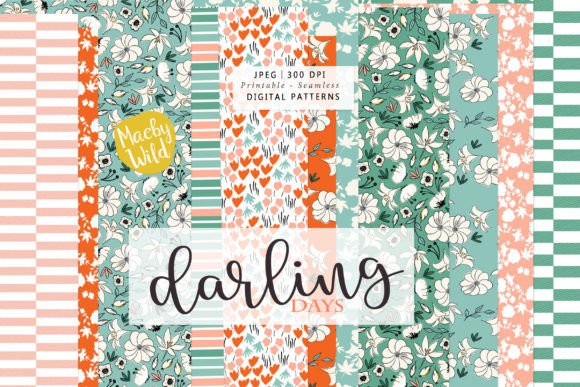
Floral digital papers are a staple for designers, crafters, and event planners seeking cohesive, printable textures that hold up across formats—from wedding stationery to journal covers. Among the many floral pattern collections available, Darling Days Flower Seamless Patterns stands out not for flashiness, but for thoughtful cohesion: soft green, peachy pink, warm orange, and deep dark green form a grounded, garden-inspired palette that avoids trend-driven saturation while remaining versatile across seasons and styles.
What Makes Darling Days Flower Seamless Patterns Distinct?
This collection isn’t built around maximalist blooms or photorealistic photography. Instead, it blends hand-drawn line work and delicate painted motifs—each originally created in a small garden studio—then digitally refined into seamless repeats. The result is a tactile, human-scaled aesthetic: petals retain subtle variation, stems show gentle curvature, and negative space feels intentional rather than empty. Unlike generative-AI patterns or mass-produced stock assets, these carry quiet consistency in stroke weight, colour harmony, and compositional rhythm.
Each of the six core designs appears in three co-ordinated colourways—soft green, peachy pink, and dark green—yielding 18 total JPEG files. All are sized at 3600px × 3600px (12 × 12 inches at 300 DPI), RGB colour mode, ready for both screen use and high-fidelity home or commercial printing. There’s no subscription, no watermarks, and no licensing ambiguity: it’s a one-time purchase with immediate download access.
How It Compares With Other Floral Pattern Options
When evaluating floral digital papers, users often weigh three practical dimensions: visual authenticity, technical readiness, and adaptability across projects. Here’s where Darling Days Flower Seamless Patterns fits within that landscape:
- Hand-crafted origin vs. algorithmic generation: Many modern pattern libraries rely on AI-assisted repeats or vector-based automation. While efficient, those can lack nuance in texture, scale variation, or organic asymmetry. Darling Days patterns preserve the slight irregularities of ink lines and watercolour bleed—ideal when you want warmth over precision.
- Seamless JPEGs vs. layered PSDs or vector EPS: This collection delivers clean, print-ready JPEGs—not editable layers or scalable vectors. That’s a tradeoff: you gain plug-and-play simplicity (no software learning curve) but lose flexibility for recolouring or motif isolation. If your workflow depends on adjusting individual elements or exporting transparent PNGs, this format may require supplemental editing.
- Curated palette vs. broad colour libraries: With only four base hues across coordinated variations, the palette is intentionally restrained. It won’t suit every brand identity—especially those requiring neon accents, monochrome minimalism, or seasonal pastels like mint or lavender. But for weddings rooted in earthy elegance, garden parties, botanical-themed journals, or handmade greeting cards, the limited range becomes an advantage: less decision fatigue, stronger visual unity.
Real-World Use Cases Where It Excels
Practical fit matters more than theoretical appeal. Based on how designers actually apply floral papers, Darling Days Flower Seamless Patterns performs especially well in these scenarios:
- Wedding invitation suites: The soft green and peachy pink pair naturally with cream cardstock, letterpress text, and dried-flower embellishments. Because all 18 files share consistent scale and density, you can mix a line-drawing border with a painted background without visual clash—a common pain point when combining third-party patterns.
- Scrapbooking and memory keeping: Journalers and scrapbookers benefit from the balance of detail and breathing room. Motifs are legible at small scales (e.g., 2-inch photo corners) but don’t overwhelm full-page layouts. The dark green variant adds grounding contrast without heaviness—useful for autumnal or winter celebrations.
- Home-printed event materials: At 300 DPI and JPEG format, files render predictably on consumer-grade inkjet printers. No colour profile mismatches or transparency glitches—just what you see on screen, reliably printed. That reliability is rare among free or low-cost pattern bundles, which often skimp on resolution or embed compression artifacts.
Situations Where You Might Look Elsewhere
That said, Darling Days Flower Seamless Patterns isn’t universally optimal. Consider alternatives if:
- You need transparency support—for overlays, clipping masks, or digital mockups—since JPEGs lack alpha channels. A PNG-based collection would serve better here.
- Your project demands strict colour matching to Pantone references or brand guidelines. While RGB is standard for screen and general print, offset or silk-screen workflows sometimes require CMYK conversion—and this collection doesn’t include pre-converted files.
- You’re designing for large-format applications (e.g., fabric printing, wall decals). Though 3600px is ample for 12-inch squares, scaling beyond 24 inches may reveal pixelation unless resampled carefully.
- You prefer modular design: being able to extract single blossoms, leaves, or vines as standalone elements. Since these are seamless repeats—not source vectors or layered files—you’d need to manually isolate motifs using selection tools, which adds time and may affect fidelity.
Making a Practical Decision
Choosing floral patterns isn’t just about aesthetics—it’s about workflow alignment. Ask yourself:
- What’s my primary output format? If most of your work ends up printed on paper (invitations, cards, scrapbook pages), JPEGs at 300 DPI are perfectly adequate—and often preferable for their simplicity.
- How much time do I have to prepare files? Instant-download, print-ready assets let you move from idea to output in minutes. If you’re under deadline pressure for a client or personal event, that speed has tangible value.
- Do I prioritise cohesion or customisation? If building a unified visual language matters more than tweaking individual components, the curated consistency of Darling Days Flower Seamless Patterns reduces trial-and-error. But if your process relies heavily on recombining, recolouring, or layering, explore vector or layered PSD options instead.
There’s no universal “best” floral pattern resource—only what fits your current constraints, tools, and creative goals. Darling Days Flower Seamless Patterns meets a specific, well-defined need: accessible, garden-soft, print-ready florals for people who value quiet craftsmanship over visual noise. It’s designed for those who create invitations by hand, fill journals with intention, or plan celebrations rooted in natural warmth—not algorithmic perfection.
If you’re evaluating options, compare not just appearance, but how each collection behaves in your actual workflow: Does it integrate smoothly into your layout software? Does its colour range complement your existing materials? Does its file structure match your printing method? Those practical questions often matter more than subjective beauty—and they’re where Darling Days Flower Seamless Patterns earns its place as a reliable, grounded choice.