Banana Seamless Patterns, Fruit Papers: A Strategic Creative Asset for Modern Design Workflows
For professionals navigating fast-paced creative environments—whether freelance designers crafting brand identities, marketing teams developing seasonal campaigns, or product entrepreneurs launching lifestyle goods—access to high-fidelity, purpose-built digital assets isn’t just convenient—it’s operational leverage. Banana Seamless Patterns, Fruit Papers exemplifies this shift: a curated, production-ready collection designed not as decorative afterthoughts, but as foundational elements that align with contemporary design expectations, technical standards, and commercial realities.
What Banana Seamless Patterns, Fruit Papers Actually Is—Beyond the Surface
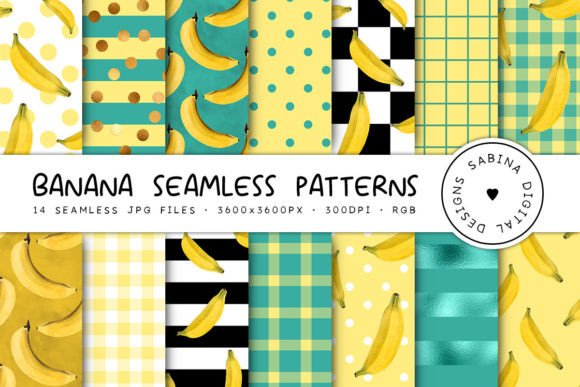
Banana Seamless Patterns, Fruit Papers is a cohesive digital pattern suite centered on tropical fruit motifs—primarily banana-based—but executed with sophistication, consistency, and technical precision. It is not a generic clipart bundle or a low-resolution web graphic pack. Instead, it delivers 14 JPG files, each engineered for professional use: pixel dimensions of 3600×3600, print dimensions of 12″×12″, color mode set to RGB, and resolution locked at 300 DPI. This specification reflects an intentional bridge between screen-based ideation and physical output—supporting everything from social media banners and presentation decks to printed packaging, fabric swatches, and stationery prototypes.
Crucially, “seamless” here isn’t just a stylistic descriptor—it’s a functional guarantee. Each pattern repeats flawlessly across any surface without visible joins, tiling errors, or distortion. That seamlessness translates directly into time saved in Adobe Illustrator or Figma, reduced risk in print preflight, and greater flexibility when scaling across formats—from Instagram Story overlays to large-format wall graphics.
Why This Type of Pattern Suite Fits Today’s Creative and Business Landscape
The rise of Banana Seamless Patterns, Fruit Papers mirrors broader industry movements: the accelerating demand for ready-to-deploy creative infrastructure. In 2024, speed-to-market matters more than ever—not at the expense of quality, but in service of it. Brands no longer have the luxury of building every visual element from scratch. Instead, they rely on modular, high-integrity components that uphold aesthetic cohesion while enabling rapid iteration.
This trend intersects powerfully with three converging developments:
- Remote-first creative collaboration: Teams distributed across time zones need shared, standardized assets—files that behave predictably in cloud-based tools like Canva, Figma, or Adobe Creative Cloud. The consistent 3600×3600 dimension and RGB/300 DPI specs ensure cross-platform reliability, eliminating version confusion or last-minute resampling.
- The resurgence of tactile, nature-infused branding: Consumers increasingly associate warmth, authenticity, and sustainability with organic forms—especially fruit, foliage, and botanical textures. Banana motifs, in particular, carry layered connotations: tropical vibrancy, natural abundance, and approachable energy. When applied thoughtfully—as background layers on eco-product labels or subtle textures in wellness app interfaces—they reinforce brand values without overt messaging.
- Print-on-demand (POD) and small-batch manufacturing: Entrepreneurs launching apparel lines, notebooks, or home goods benefit immensely from patterns built to POD specifications. The 12″×12″ print dimension matches standard fabric yardage and paper sheet sizing used by platforms like Printful, Gelato, and Gooten. No cropping, no guesswork—just upload and produce.
Shifting Expectations: From “Nice to Have” to “Must-Integrate”
A decade ago, designers often treated pattern libraries as supplemental inspiration—something browsed occasionally for mood boards or one-off projects. Today, patterns function more like typography or color systems: core components of a brand’s visual language. This evolution changes how professionals evaluate resources like Banana Seamless Patterns, Fruit Papers.
Consider a real-world scenario: A freelance packaging designer is commissioned to develop labels for a new line of cold-pressed banana-based smoothie shots. The client emphasizes “fresh, joyful, grounded”—not “cartoonish” or “generic tropical.” Rather than spending hours sourcing, editing, and testing disparate banana illustrations, the designer deploys one of the 14 patterns as a subtle background texture behind clean sans-serif typography. Because the file is 3600×3600 and 300 DPI, it scales crisply across label variants (2 oz vial, 12 oz bottle, 32 oz family jug) and renders accurately both on screen and in CMYK proofing—no reworking required.
That efficiency isn’t incidental. It’s the result of deliberate alignment between asset design and modern workflow constraints: tight deadlines, multi-channel delivery (web, social, print), and increasing client expectations around consistency and polish.
Technical Precision as a Competitive Differentiator
Not all seamless patterns are created equal—and not all “high-res” claims hold up under scrutiny. Many free or low-cost downloads deliver files labeled “300 DPI” but embedded at 72 PPI, or sized inconsistently (e.g., 2000×2000 or 5000×5000), forcing users to interpolate, crop, or adjust color profiles mid-project. These friction points compound rapidly in team settings, where inconsistent assets trigger revision cycles and misaligned outputs.
Banana Seamless Patterns, Fruit Papers avoids those pitfalls by adhering to production-grade standards out of the box. The fixed 3600×3600 dimension ensures predictable tiling behavior in CSS background-repeat, Illustrator pattern swatches, and Procreate canvas fills. The RGB color mode supports accurate on-screen previewing—critical for digital-first clients—and maintains fidelity during soft-proofing before CMYK conversion. And because all 14 files share identical technical parameters, designers can mix and match patterns within a single project without introducing scaling artifacts or color shifts.
This level of uniformity signals deeper intentionality: the collection wasn’t assembled for volume, but for utility. Each pattern offers distinct rhythm, density, and compositional balance—some emphasize linear stem structures, others focus on clustered fruit silhouettes or abstracted peel textures—yet all operate within the same technical and aesthetic framework.
Connecting to Larger Creative Infrastructure Trends
The success of specialized pattern suites like Banana Seamless Patterns, Fruit Papers reflects a maturing ecosystem around design ops—the operational layer that supports creative work at scale. Just as developers rely on well-documented component libraries and design systems, creatives increasingly depend on interoperable, spec-compliant asset repositories.
We’re also seeing a quiet pivot away from “one-size-fits-all” stock resources toward niche-optimized collections. Rather than sifting through thousands of generic fruit patterns, professionals seek focused sets built for specific applications: food branding, sustainable packaging, wellness visuals, or summer campaign assets. Banana motifs, in particular, offer versatility across categories—equally effective in children’s educational materials, gourmet food labeling, or boutique skincare launches—without requiring heavy stylization.
Moreover, this specificity supports accessibility-conscious design. High-resolution, cleanly rendered fruit forms—free of visual noise or excessive detail—provide strong contrast and legibility when used as subtle backgrounds behind text. When paired with accessible typography and sufficient color contrast, these patterns enhance rather than compete with readability—a practical consideration often overlooked in decorative asset curation.
Practical Integration Across Roles
How do different professionals actually use Banana Seamless Patterns, Fruit Papers in daily practice?
- Marketing Managers: Embed patterns into email newsletter templates or landing page backgrounds to reinforce seasonal campaign themes—e.g., using a lighter, airy banana motif for a spring refresh, then switching to a bolder, saturated version for summer promotions—all while maintaining brand consistency.
- Product Entrepreneurs: Apply patterns directly to mockup templates for Kickstarter campaigns or Shopify product pages, ensuring visual continuity from concept to launch. The 12″×12″ size works natively with most 3D mockup generators, reducing post-production labor.
- UX/UI Designers: Use scaled-down versions (via smart object resizing) as subtle surface textures in dashboard cards or app onboarding screens—adding depth and thematic resonance without compromising interface clarity.
- Freelance Illustrators: Layer patterns beneath hand-drawn elements to add dimensional richness, or extract individual banana shapes as reusable vector-ready components—accelerating custom illustration workflows.
In each case, the value lies not in novelty alone, but in reliability: knowing that the file will perform as expected, integrate smoothly, and uphold professional standards across touchpoints.
Conclusion: Patterns as Purpose-Built Infrastructure
Banana Seamless Patterns, Fruit Papers represents more than a themed graphic pack. It embodies a growing recognition among creators and businesses alike: that high-caliber, technically sound, context-aware digital assets are no longer peripheral—they’re essential infrastructure. In an era defined by velocity, cross-platform delivery, and heightened audience expectations, having 14 rigorously built, seamlessly repeating, production-ready JPG files isn’t just helpful. It’s a strategic advantage—one that saves time, reduces friction, and strengthens visual storytelling at every stage of the creative process.
When your next project calls for warmth, vitality, and unmistakable tropical character—backed by precision you can trust—Banana Seamless Patterns, Fruit Papers delivers not just imagery, but operational confidence.