Watercolor Patterns Clover, Jpeg
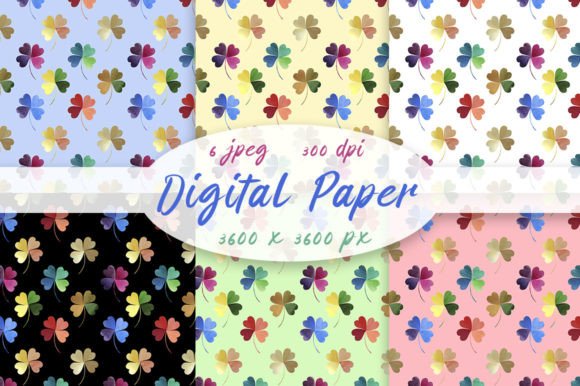
If you’ve ever spent 20 minutes searching for the perfect subtle clover motif that doesn’t look clip-art or overly saturated—only to settle for something “good enough”—you’re not alone. Watercolor Patterns Clover, Jpeg is designed for those moments: six seamless, hand-painted digital papers in high-resolution JPEG format (3600×3600 pixels at 300 dpi), each built around soft, organic clover shapes with gentle watercolor texture and natural variation.
These aren’t vector repeats or AI-generated loops. They’re scanned, layered, and refined watercolor illustrations—so each pattern breathes like real paper. That means subtle granulation, light bleed, and gentle pigment shifts—not uniform repetition. You’ll notice it most when printed on textured cardstock or viewed at full size on screen: no harsh edges, no robotic symmetry, just quiet botanical charm.
Where These Patterns Fit Into Real Creative Work
Think of Watercolor Patterns Clover, Jpeg as a quiet utility player—not flashy, but dependable across dozens of everyday projects. Here’s how people actually use them:
- Small business owners drop one into Canva or Adobe Express to build branded social media templates—say, a spring-themed Instagram story for a local florist or apothecary. The clover motif hints at renewal and nature without shouting about it. Because it’s seamless, they can tile it across a full background without visible seams—even behind text overlays.
- Educators and homeschoolers use one pattern as a printable worksheet border for a botany unit, or as a calming visual anchor on a reading log. The soft green tones are easier on young eyes than bright solids, and the clover shape invites gentle discussion (“How many leaves? What do you notice about the shape?”).
- Bloggers and content creators layer a low-opacity version behind blog headers or email newsletter banners. It adds depth without competing with copy—and because it’s JPEG (not PNG), it loads quickly even on mobile. No transparency fuss, no extra export steps.
- Handmade product sellers (think greeting cards, stationery, or fabric-printed pouches) use these as base layers before adding foil stamping mockups or embroidery guides. The 300 dpi resolution holds up cleanly when scaled down for print proofs or uploaded to print-on-demand platforms like Printful or Gelato.
Why JPEG Format Matters More Than You Might Think
Some designers default to PNG for everything—but Watercolor Patterns Clover, Jpeg uses JPEG intentionally. It’s not about cutting corners; it’s about compatibility and workflow fit. JPEGs open instantly in free tools like Google Slides, PowerPoint, Pages, or even basic photo editors. No need to convert, no alpha-channel confusion, no “why won’t this import?” moments.
That also means faster uploads to platforms with strict file-type rules—like Etsy listing builders, Mailchimp template editors, or WordPress media libraries. And since each file is optimized (not compressed to oblivion), you get rich color and fine detail without bloated file sizes. One pattern averages under 4 MB—small enough to email to a collaborator or stash in a cloud folder alongside other brand assets.
What to Keep in Mind Before You Use Them
First: monitor variance is real. If you’re matching this pattern to a specific Pantone green in your logo, test a small print first. The watercolor pigments were mixed by hand, then scanned under consistent lighting—but your screen’s white point, brightness, and calibration will shift how emerald or sage the clovers appear. A quick test print on your usual paper stock solves this fast.
Second: seamless doesn’t mean invisible. When tiled at large scale (e.g., a 24×36” wall graphic), the repeat rhythm may become noticeable if you zoom in closely. That’s normal—and often desirable for texture—but if you need absolute randomness, pair one pattern with a light noise overlay or subtle grain filter in Photoshop or Affinity Photo.
Third: while these work beautifully in commercial projects (yes, you can use them in client deliverables), always check your platform’s license terms. This set includes standard commercial use rights—no attribution required—but resale as standalone digital paper is not permitted. You *can* use it in a custom wedding invitation suite you design and sell, but you *can’t* repackage and resell the files themselves on another marketplace.
Real-Life Scenarios Where These Patterns Save Time & Add Warmth
A freelance graphic designer had a last-minute request: refresh a wellness coach’s PDF workbook cover. She dropped one clover pattern into Illustrator as a background layer, added a semi-transparent white rectangle over it for readability, and adjusted the blend mode to “Soft Light.” Done in under seven minutes—no custom illustration, no stock photo hunt, no licensing back-and-forth.
A middle school art teacher needed a low-prep way to introduce pattern-making. She projected one of the clover papers, froze the frame, and asked students to sketch what they saw—then compared their interpretations to the original. The watercolor texture sparked conversation about “imperfection as part of the process,” which bled naturally into their own ink-and-brush exercises.
A candle maker used one pattern as the background for her seasonal label mockup—then exported it as a flattened JPEG to send to her printer. No layers to manage, no bleed worries, no font embedding issues. Her printer confirmed it met their specs on the first try.
How to Get the Most Out of These Six Patterns
Don’t treat them as six separate backgrounds. Try stacking two at different opacities in your editor—say, a lighter clover pattern at 30% over a deeper green one at 70%. You’ll get richer depth and a sense of handmade layering. Or invert one in Photoshop (Image > Adjustments > Invert) to create an unexpected cream-on-forest backdrop—great for minimalist packaging or elegant email footers.
For digital planners or Notion users: import one as a page background image (using a browser extension or custom CSS), then add your weekly layout on top. The soft texture reduces screen glare fatigue during long planning sessions—more so than stark white or solid pastels.
And if you're building a mood board for a spring rebrand? Pin one pattern next to actual fabric swatches, dried clover stems, and matte ceramic photos. Its tactility bridges digital and physical in a way flat vectors rarely do.
At its core, Watercolor Patterns Clover, Jpeg isn’t about chasing trends—it’s about having a thoughtful, ready-to-use tool that fits quietly into your existing process. Whether you’re designing for clients, teaching a class, launching a product, or just making something lovely for yourself, these patterns offer consistency without rigidity, charm without clutter, and quality that holds up—whether on screen or in print.