Line Digital Paper Patterns: Redefining Precision, Flexibility, and Workflow Integration for Modern Creators
In an era where digital tools are no longer just supplements—but foundational infrastructure—Line Digital Paper Patterns has emerged as a quietly transformative resource for professionals across design, manufacturing, education, and creative entrepreneurship. Unlike generic digital templates or static vector files, Line Digital Paper Patterns refers to a curated, high-fidelity collection of scalable, print-ready pattern assets delivered in JPG format—each optimized for clarity, dimensional accuracy, and immediate integration into real-world workflows. These aren’t decorative graphics; they’re functional, measurement-anchored references designed to support precise physical output—from prototyping textiles and packaging to constructing architectural models and educational manipulatives.
A Convergence of Craft, Computation, and Contextual Demand
The rise of Line Digital Paper Patterns reflects deeper shifts across multiple domains. First, there’s the accelerating normalization of hybrid workflows—where digital ideation meets tangible execution. Designers sketch in Figma or Illustrator, then move seamlessly to laser cutting, CNC milling, or hand assembly. In that transition, fidelity matters: a 0.2mm misalignment in a printed pattern can cascade into structural failure or costly rework. Line Digital Paper Patterns meet this need with calibrated line weights, consistent DPI (300+), and standardized scale markers embedded directly into each JPG—no interpretation required.
Second, it aligns with the growing expectation for interoperable simplicity. Professionals no longer want to wrestle with layered PSD files, proprietary software dependencies, or SVG scaling inconsistencies. JPG may seem “basic”—but its universal compatibility means these patterns open instantly in Canva, Adobe Express, Microsoft PowerPoint, Google Slides, or even offline presentation tools on tablets and kiosks. That universality isn’t a compromise—it’s strategic. A freelance packaging designer in Jakarta can share a Line Digital Paper Pattern with a local print house via WhatsApp; a STEM educator in Lisbon can project it onto a classroom wall and trace it freehand with students—all without installing new software or converting formats.
Why Attention Is Shifting Toward Purpose-Built Pattern Assets
Creators aren’t just noticing Line Digital Paper Patterns—they’re adopting them because legacy alternatives no longer match how work gets done. Consider three evolving realities:
- Remote collaboration intensity: With distributed teams handling everything from concept to fabrication, shared visual anchors are essential. A JPG-based pattern serves as a single source of truth—version-controlled, easily annotated, and embeddable in Notion, ClickUp, or Confluence without rendering issues.
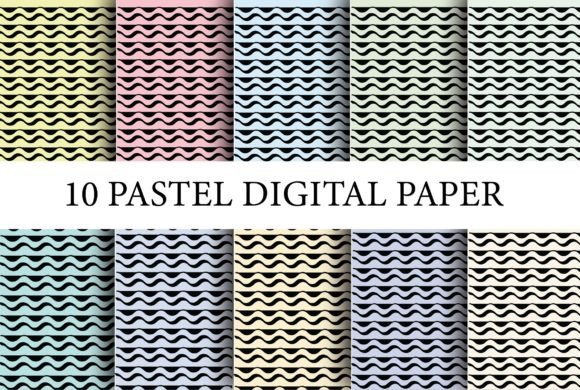
- Hardware democratization: Affordable desktop cutters (like Cricut Maker 3 or Silhouette Cameo 4), entry-level laser engravers, and even precision craft knives now sit on home desks and small studio benches. These tools rely on clean, high-contrast outlines—exactly what Line Digital Paper Patterns deliver in their 10 optimized JPGs.
- Time-as-a-strategic-resource: Entrepreneurs launching physical products—custom stationery, modular furniture kits, or eco-friendly apparel prototypes—can’t afford days lost to file troubleshooting. Line Digital Paper Patterns reduce setup time from hours to minutes, letting creators focus on iteration, user feedback, and market validation.
Practical Integration: Beyond the Download
Let’s ground this in practice. A product designer developing a collapsible bamboo laptop stand doesn’t begin with CAD—they start with rapid physical mockups. Using one of the Line Digital Paper Patterns, they print a scaled orthographic layout onto cardstock, score and fold along the pre-defined crease lines (visible as fine 0.5pt black strokes), and test ergonomics before committing to CNC toolpaths. The same JPG file later becomes the basis for laser-cutting instructions—its pixel-perfect edges aligning precisely with the machine’s registration system.
Similarly, a marketing agency building experiential pop-up displays uses another of the 10 JPGs—a modular grid pattern—to prototype signage frames. Because each tile includes embedded millimeter rulers and alignment crosshairs, their junior designer verifies spacing consistency across six regional installations—without needing access to licensed design software or engineering review.
Even educators leverage this utility. A university industrial design instructor assigns a sustainability challenge: “Design a zero-waste packaging solution using only recycled cardboard.” Students receive three Line Digital Paper Patterns—a hexagonal honeycomb tessellation, a nested sleeve structure, and a self-locking box base. Each JPG includes not just geometry but contextual notes: recommended material thicknesses, grain-direction indicators, and fold-angle tolerances. Learning becomes tactile, standards-aligned, and scalable across 40+ students using diverse devices.
Bridging the Physical-Digital Divide—Without Abstraction
Many digital tools overpromise “seamless” integration but underdeliver on context. They assume users have advanced technical literacy—or that all outputs happen in controlled environments. Line Digital Paper Patterns rejects that assumption. It operates at the intersection of accessibility and precision: JPG is universally understood, yet each file is engineered with professional-grade constraints.
This approach mirrors broader industry movements—like the resurgence of analog-adjacent digital tools (e.g., Notion’s whiteboard mode, Miro’s printable templates) or the emphasis on “low-code physical computing” in hardware startups. It’s also aligned with sustainability imperatives: reducing digital bloat (no unnecessary layers or metadata), minimizing print errors (and thus paper waste), and supporting local, small-batch production ecosystems.
Importantly, Line Digital Paper Patterns does not replace CAD, BIM, or parametric modeling. Rather, it complements them—serving as the trusted handoff layer between abstract digital models and grounded physical action. Think of it as the “last-mile delivery” for design intent: where intention becomes instruction, and instruction becomes object.
Looking Ahead: Standards, Scalability, and Shared Literacy
As adoption grows, so does opportunity—not just for more patterns, but for shared conventions. The current set of 10 JPGs already demonstrates early standardization: consistent bleed margins (3mm), CMYK-safe grayscale rendering, and embedded copyright-free usage licensing for commercial derivatives. Future iterations may incorporate QR-linked metadata (e.g., material recommendations or video assembly guides), or optional AR overlays viewable through standard mobile browsers—enhancing utility without compromising core accessibility.
What makes Line Digital Paper Patterns forward-looking isn’t novelty—it’s intentionality. It anticipates that tomorrow’s most impactful tools won’t be the flashiest, but the ones that remove friction without removing fidelity; that empower without overcomplicating; and that treat every creator—not just those with enterprise licenses—as a legitimate node in the global making ecosystem.
For professionals navigating tightening deadlines, expanding scope, and increasingly diverse stakeholder needs, Line Digital Paper Patterns offers something rare: confidence at the interface of screen and surface. It’s not about digitizing paper—it’s about honoring the enduring value of clear lines, shared understanding, and work that holds up in the real world.
Whether you’re iterating a wearable tech enclosure, teaching spatial reasoning to middle-schoolers, or sourcing sustainable packaging for a DTC brand, the 10 JPGs in the Line Digital Paper Patterns collection serve as quiet enablers—precise, portable, and perpetually ready to translate vision into form.
Explore the full set of Line Digital Paper Patterns—including technical specifications, recommended printing settings, and use-case briefs—at linedigitalpaperpatterns.example.