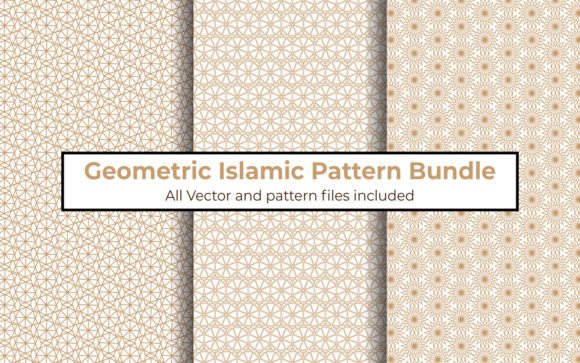
Islamic Style Seamless Patterns Set
Designers, textile artists, and small business owners often face a recurring challenge: finding culturally resonant, production-ready patterns that align with both aesthetic integrity and technical requirements. The Islamic Style Seamless Patterns Set answers that need—not as a decorative afterthought, but as an integrated asset in the early planning and execution phases of visual projects. It’s not just about adding “Arabic-inspired” visuals; it’s about working with geometry rooted in centuries of Islamic art tradition—precision, symmetry, repetition, and balance—packaged for modern digital workflows.
Where This Set Fits in Your Creative Process
The Islamic Style Seamless Patterns Set functions most effectively when introduced early—not during final tweaks, but during concept development or mood board assembly. For example, if you’re designing a line of modest fashion apparel, launching a boutique home goods brand, or producing educational materials on cultural heritage, selecting a foundational pattern before committing to color palettes or layout structures helps maintain visual cohesion across touchpoints. Because these are seamless vector files, they scale without degradation and adapt cleanly to varied substrates: woven cotton, ceramic tile layouts, digital newsletters, or embossed packaging.
Unlike raster-based downloads or single-use JPEGs, this set includes AI and EPS vector files—meaning they integrate directly into Adobe Illustrator, CorelDRAW, or Affinity Designer without conversion steps. That compatibility reduces friction between ideation and output, especially when collaborating with printers or production partners who require native vector input.
Practical Use Cases Across Industries
Small business owners use the Islamic Style Seamless Patterns Set to unify branding elements efficiently. A halal-certified food brand might apply one of the three included patterns as a subtle background on product labels, then reuse the same motif—recolorized—to line gift boxes or structure website section dividers. Consistency emerges not from repetition alone, but from shared underlying geometry: the same 8-point star grid appears in both packaging and social media banners, reinforcing brand recognition without visual fatigue.
Educators and curriculum designers incorporate these patterns into printable worksheets, presentation templates, or classroom decor—particularly in units covering Islamic art history, geometry in culture, or cross-curricular STEAM activities. Since each pattern is built on mathematically sound tiling logic, they serve dual purposes: visual appeal and teachable structure. Teachers report stronger student engagement when geometric reasoning is grounded in real-world examples like mosque tilework or manuscript illumination.
Freelance surface designers rely on the set’s ease of color customization. With only three core patterns—but full flexibility in hue, saturation, and contrast—you can generate dozens of variations without redrawing. One designer used a single base pattern to create six distinct fabric collections for a Ramadan capsule line, adjusting palette tone (warm golds vs. cool indigos) and contrast levels (high-contrast black/white vs. tonal cream-on-ivory) to match seasonal themes and target demographics.
Workflow Integration Tips
Pre-project preparation: Before starting a new brief, open the AI files and assign consistent layer naming conventions—e.g., “Base_Tiling,” “Color_Overlay,” “Registration_Marks.” This habit saves time when revisiting assets months later or handing off to another team member.
During production: Use the seamless nature of the patterns to build modular templates. In Illustrator, create a master swatch library with recolored versions saved as global swatches. That way, changing the primary accent color across all pattern applications takes one edit—not dozens.
Post-delivery refinement: When preparing files for print vendors, export EPS versions with embedded fonts (if any text is layered) and confirm bleed and trim settings match the printer’s specifications. Because the patterns are vector-based, they retain sharpness even at large-format sizes—ideal for wallpaper murals or trade show backdrops.
Compatibility & Usability Considerations
The set includes three distinct geometric motifs—each derived from classical Islamic design principles such as girih tiling and strapwork—but avoids literal replication of sacred inscriptions or religious iconography. This makes them suitable for secular and faith-aligned contexts alike. Designers appreciate that no licensing restrictions limit usage across commercial products, client work, or personal portfolios.
File organization matters: keep the original AI files untouched in a master folder, and save edited variants with descriptive names (e.g., “ISPS_SeaStar_BlueGold.ai”). Avoid renaming or flattening layers unless necessary—preserving editable paths ensures future adjustments remain precise.
Long-Term Value and Quality Control
Over time, users notice how consistency compounds. A stationery brand that launched with one pattern from the set later expanded its greeting card line using the same underlying geometry—just rotated, mirrored, or layered with opacity changes. Customers recognized the visual thread, increasing repeat purchases. That kind of organic brand continuity doesn’t happen by accident; it happens when foundational assets are both culturally grounded and technically robust.
Quality control starts with testing at multiple scales. View each pattern at 50% zoom (for web UI backgrounds), 100% (for fabric repeats), and 400% (to inspect anchor point precision). All three patterns in the Islamic Style Seamless Patterns Set hold up under scrutiny—no stray nodes, inconsistent spacing, or misaligned joins. That attention to vector hygiene means fewer revisions during prepress and smoother handoffs to manufacturers.
Strategic Implementation Observations
- Efficiency gain: One user reduced pattern-related revision cycles by 60% after switching from custom-drawn repeats to this vetted set—time previously spent fixing alignment issues was redirected toward typography refinement and user testing.
- Cross-platform consistency: Using the same vector source across Shopify product mockups, Canva social templates, and PDF lookbooks eliminated mismatched scaling or pixelation issues.
- Client confidence: Presenting pattern options with clear documentation—“based on 12th-century Andalusian tile geometry, fully scalable, CMYK and RGB ready”—adds credibility during pitch meetings, especially with culturally conscious clients or institutions.
Ultimately, the Islamic Style Seamless Patterns Set works best when treated not as decoration, but as infrastructure—as reliable and reusable as a well-organized font library or standardized color system. Its value multiplies when aligned with intentional planning: choosing which pattern supports your message, how color shifts affect emotional resonance, and where repetition reinforces rather than overwhelms. That level of integration doesn’t require advanced technical skill—it requires clarity of purpose and respect for the tradition behind the geometry.
If you're evaluating whether this set fits your current or upcoming projects, ask yourself: Does this support my workflow—or interrupt it? Will it simplify decisions, or add complexity? When sourced and applied deliberately, the answer is consistently yes.